
On this page
RTP tells you the theoretical long-term return of a casino game; volatility tells you how unevenly its payouts may arrive. Neither predicts the next spin. Two pokies can both have a 96% return to player (RTP) while producing markedly different patterns of wins, losing streaks and balance swings. The useful comparison is therefore not “RTP or volatility-” but what each number can - and cannot - tell you before you play.
For New Zealand players, there is a further check: the RTP quoted on a review site may not be the RTP configuration offered by the casino displaying the game. The in-game information screen is a better starting point than a ranking labelled “best payout pokies”.
RTP vs volatility at a glance
| Question | RTP (return to player) | Volatility (variance) |
|---|---|---|
| What does it measure- | Expected return as a share of all stakes across a very large number of outcomes. | The extent to which payouts vary around their expected value. |
| Typical display | A percentage, such as 96%. | Low, medium, high or very high; sometimes a numeric rating. |
| What does a higher value imply- | A lower mathematical house edge, all else equal. | Generally greater payout swings and a less even win pattern. |
| Does it forecast the next spin- | No. | No. |
| What should you verify- | The exact game version and RTP setting in the paytable or help menu. | The provider's volatility classification and game mechanics. |
| What does it not reveal- | How frequently wins occur or how large any one win will be. | The game's long-run return percentage or the timing of a jackpot. |
What does 96% RTP actually mean?
Return to player is a mathematical expectation built into the game. A slot with a theoretical RTP of 96% is designed so that, across a sufficiently large volume of total wagers, the expected aggregate payout is NZ$96 per NZ$100 wagered. The remaining 4% is the house edge. This describes an expectation over turnover, not a promise to an individual player.
House edge = 100% − RTP. A 96% RTP corresponds to a 4% house edge; a 94% RTP corresponds to 6%. Given the same amount wagered, the 94% game has the greater expected loss. These percentages do not specify the chance of finishing a particular session ahead.
Consider NZ$1 spins with a total turnover of NZ$500. At 96% RTP, the theoretical expected payout is NZ$480 and the expected net loss is NZ$20. That calculation does not mean that depositing NZ$50 produces a NZ$20 loss, or that making 500 spins yields exactly NZ$480 in winnings. Re-staked winnings count towards turnover, and actual outcomes may deviate sharply from the average.
The actual RTP observed over a short session is simply total winnings divided by total stakes. It can sit far above or below the certified theoretical RTP. A sample of a few dozen, hundreds or even thousands of spins cannot prove that a particular slot is “due” to return its advertised percentage. The long-term average is a property of the game mathematics, not a schedule of repayments.
What does volatility mean in online slots?
Slot volatility describes the spread of possible payouts. In mathematical terms, variance measures dispersion around the expected return, while standard deviation is the square root of variance. Casino Basics often use “volatility” and “variance” interchangeably, but supplier ratings do not follow a single industry-wide numerical scale.
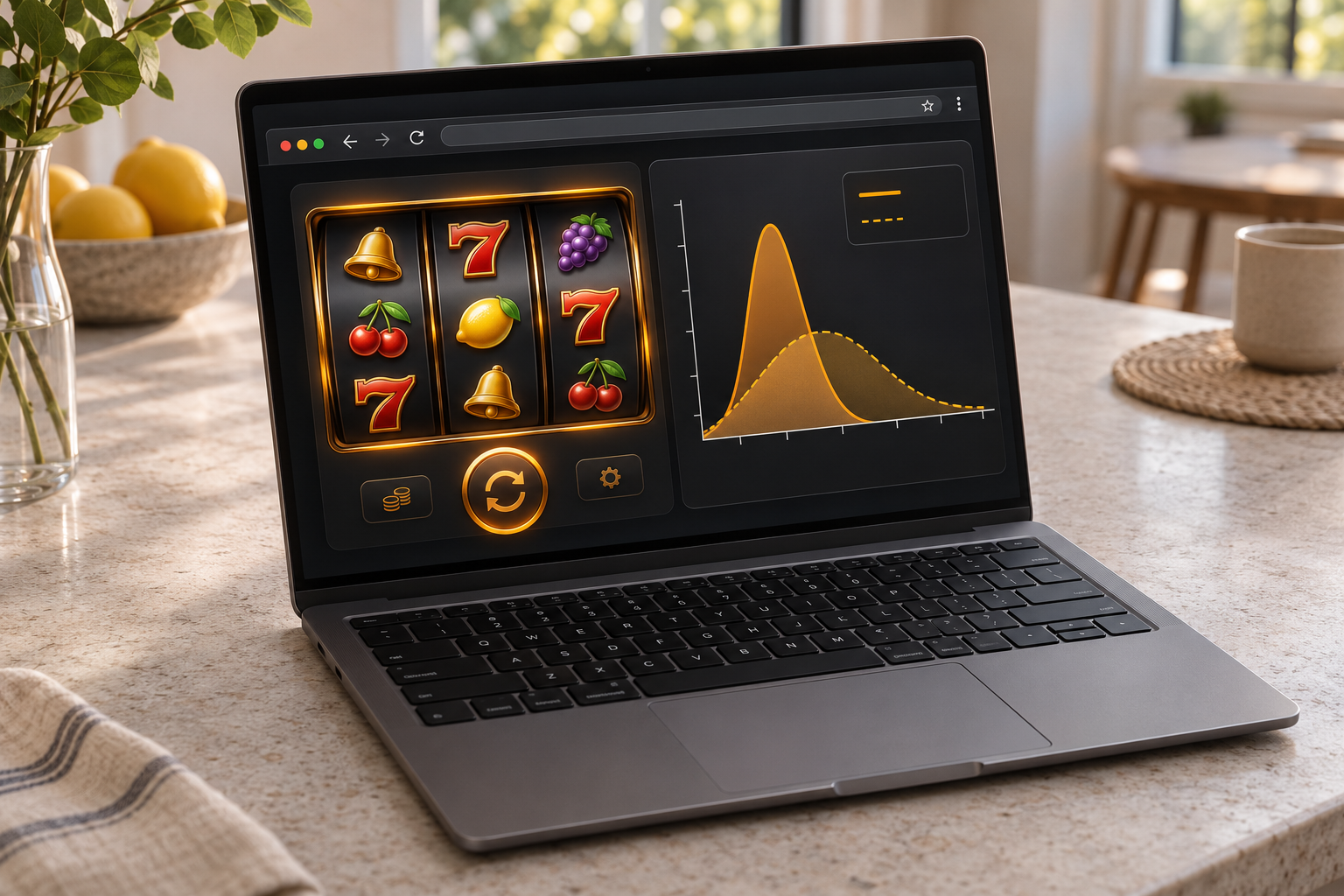
Low-volatility pokies generally place more of their payout value in relatively frequent, smaller wins. High-volatility pokies tend to have a more uneven payout distribution: quiet stretches can be interrupted by larger wins, including outcomes linked to free spins, multipliers or bonus rounds. A medium-volatility slot sits somewhere between these designs, but labels such as “medium-high” and “very high” depend on the provider's classification.
High volatility does not guarantee a larger win. It signals a wider range of outcomes and can involve prolonged losing streaks or dry spells. Likewise, low volatility does not mean consistent profit: frequent small payouts may be less than the stake, so the balance can still decline.
How hit frequency differs from volatility
Hit frequency (or win frequency) is the proportion of spins producing a payout. It is not the percentage of spins that produce a net profit. For example, a NZ$1 spin that pays NZ$0.40 is technically a winning combination but leaves the player NZ$0.60 down on that spin. Payout frequency alone does not establish RTP or risk.
A slot with a high hit rate can still be volatile if a substantial share of its theoretical return is concentrated in rare high-value combinations. The paytable, bonus trigger rate, maximum win multiplier and distribution of wins matter alongside the headline rating. A progressive jackpot can introduce a further rare-event component; its contribution to RTP must not be assumed without the provider's rules.
Two 96% RTP pokies can behave very differently
Imagine two illustrative slots with identical theoretical RTP. The payout patterns below demonstrate the distinction; they are not measured results from named games.
| Feature | Slot A: lower volatility | Slot B: higher volatility |
|---|---|---|
| Theoretical RTP | 96% | 96% |
| House edge | 4% | 4% |
| Illustrative payout pattern | More frequent, usually smaller returns | Less even returns, with a greater share tied to rarer larger outcomes |
| Balance movement | Often less abrupt, though losses remain possible | Potentially sharper gains and declines |
| Can a short session lose the entire budget- | Yes | Yes |
At equal turnover, their expected loss is the same. Their probability of particular session outcomes need not be the same. Volatility helps describe how results are distributed, while RTP describes their weighted average. That is why a “96% RTP, high volatility” game is not automatically a better-paying game than a “96% RTP, low volatility” one.
Maximum win figures - for example, a 5,000× or 10,000× stake prize - do not resolve the comparison either. A maximum win states an upper payout under the specified game rules, not its likelihood, and does not show how much RTP is allocated to that rare outcome.
Which matters more when choosing a pokie?
Use RTP to compare long-run expected cost and volatility to assess how uncertain and uneven the outcomes may be. Neither makes a negative-expectation casino game a source of income. An appropriate choice depends on whether those risks are acceptable at all, not on a claim that one setting can beat the house edge.
- If two slots have different RTPs: the higher verified RTP means a lower mathematical expected loss per dollar wagered, assuming the displayed rules and wager conditions apply. It does not ensure a better session result.
- If two slots have the same RTP: their expected return is the same, but their volatility, hit frequency, bonus structures and potential payout sizes may differ.
- If predictable expenses or financial stress are concerns: neither low volatility nor high RTP makes gambling financially safe. The sound exclusion filter is to avoid staking money needed for essentials.
- If the volatility rating is missing: do not infer it solely from the theme, the maximum prize or the presence of Megaways-style mechanics. Treat the risk classification as unverified.
The distinction also applies beyond pokies, although volatility may be described differently in blackjack, roulette, video poker and other casino games. Their house edge depends on specific rules, paytables and sometimes player decisions. A slot-style volatility label should not be transferred automatically to a table game.
How to check a game's actual RTP and volatility
- Open the game information or paytable. Look for “RTP”, “theoretical return”, “game rules” or a help icon. Verify the percentage shown for that particular game session rather than relying only on a casino listing.
- Confirm the exact game and version. Developers can publish multiple RTP configurations for the same title. A review based on one operator or market may not match another operator's version.
- Look for the volatility rating. Some suppliers publish low-to-high classifications on official game sheets; others do not. Ratings from separate studios may use different methodologies.
- Read the payout mechanics. Check the winning combinations, wild symbols, scatter symbols, base-game prizes, free spins, multipliers, bonus rounds, jackpot rules and maximum win. These explain where payout value may be concentrated.
- Check game conditions before relying on a comparison. Bet size, eligible features and any bonus-buy option may alter how the game is played or how a published figure applies. Do not assume changing stakes improves RTP unless the rules explicitly say so.
Well-known titles such as Starburst, Book of Dead, Gonzo's Quest, Blood Suckers, Gates of Olympus, Sweet Bonanza, Wolf Gold and Reactoonz often appear in online pokie comparisons. Their names alone are not evidence of a particular RTP, volatility level or current availability in New Zealand. Some titles have different editions or configurable return settings.
The same rule applies when comparing suppliers including NetEnt, Play'n GO, Pragmatic Play, Microgaming, Relax Gaming, Yggdrasil, Thunderkick, Big Time Gaming and Evolution: use the individual game's information rather than attributing one RTP or volatility profile to an entire studio. A provider or review site's figure is useful supporting information, but a verifiable game-specific paytable is more relevant to the actual version presented.
Why RTP and volatility do not tell you when to stop or spin
Licensed and properly tested casino games use a random number generator (RNG) or an equivalent approved randomisation mechanism to determine results under the relevant game rules. In ordinary independent-spin slots, a past losing streak does not make a large payout more likely on the next spin. The belief that a machine is “hot”, “cold” or “due” is the gambler's fallacy.
Neither an RTP percentage nor a volatility rating reveals a clock, cycle or signal for the next bonus trigger. A reported run of wins also cannot demonstrate that a slot's certified game mathematics have changed. Similarly, a high maximum win and a high RTP are separate attributes: one describes a possible prize, the other the weighted average of all payouts.
Bankroll, session length and financial risk
A bankroll is the amount allocated to gambling, not an amount a game is expected to return. Stake size and session length influence total exposure: 200 spins at NZ$0.50 create NZ$100 of turnover; 200 spins at NZ$2 create NZ$400. If both were made on a game with 96% RTP, the theoretical expected losses on those turnovers would be NZ$4 and NZ$16 respectively. Actual losses can be much greater, including the entire amount available.
Lowering a bet size limits the amount at risk per spin but does not change a game's published expected return by itself. Extending a session to “let RTP catch up” increases exposure without creating any entitlement to recover earlier losses. Chasing losses, using borrowed money or treating a bonus feature as a recovery strategy introduces additional financial risk.
Practical harm-minimisation measures include a spending budget separate from essential expenses, loss and time limits, regular breaks, and self-exclusion where available. Deposit limits are not a substitute for affordability: they restrict access, not the underlying negative expectation. Anyone concerned about control over gambling can seek support without waiting for losses to become severe.
What New Zealand players should know

“Pokies” is the familiar New Zealand term for slot machines, including online pokies. Casino balances and stake examples may appear in NZD, but the mathematics of RTP and variance do not change with currency. A figure presented for one market or operator still needs confirmation for the particular game offered to Kiwi players.
New Zealand's Online Casino Gambling Act 2026 is in force, with the Department of Internal Affairs (DIA) implementing a phased licensing system. As at November 2026, the full licensed regime is not yet operational; the DIA expects licences to begin being issued in 2027. It would therefore be misleading to describe every casino accessible from New Zealand as NZ-licensed. Rules governing providers and advertising are also subject to the transition timetable. See the DIA's information for online casino customers and provider regulatory status for official updates.
For confidential support in New Zealand, Gambling Helpline provides help with gambling-related harm. Checking regulatory information and available support is more consequential than trying to predict when a slot will pay.
RTP vs volatility: frequently asked questions
Is high RTP better than low volatility?
They answer different questions. Higher verified RTP means a lower long-term expected loss, while lower volatility describes a less uneven payout pattern. Neither guarantees a positive session or makes a bet risk-free.
Can a low-volatility pokie have a low RTP?
Yes. Return percentage and payout variance are separate characteristics. A low-volatility slot can provide frequent small payouts while retaining a comparatively large house edge.
Does 96% RTP mean I get NZ$96 back after betting NZ$100?
No. It means an expected aggregate return of NZ$96 for every NZ$100 of total stakes over a very large number of outcomes. Your own session may produce substantially more, much less or nothing.
Do high-volatility pokies pay bigger jackpots more often?
Not necessarily. High volatility commonly involves a more uneven spread of wins, but neither the frequency of a jackpot nor the probability of a maximum win can be inferred from the label alone.
Are hit frequency and RTP the same?
No. Hit frequency counts how often an outcome pays anything; RTP takes both payout size and probability into account. A high hit rate can coexist with a low RTP.
Can I improve RTP by changing my stake or playing longer?
Not in a standard fixed-RTP game merely by doing either. Some game rules contain stake-dependent features or separate return settings, so check the actual paytable. More spins do not force the short-term result to converge to the theoretical average on your schedule.
Why do two websites show different RTPs for the same slot?
They may be quoting different game configurations, editions or outdated supplier figures. Confirm the title, version and currently displayed RTP in the game's information menu, and consider the date and source of external data.
Can RTP or volatility predict the next bonus round?
No. Neither metric forecasts an individual spin, free-spins trigger or jackpot event. For independent spins, previous results do not establish when the next payout is due.
← Back to Casino Basics